
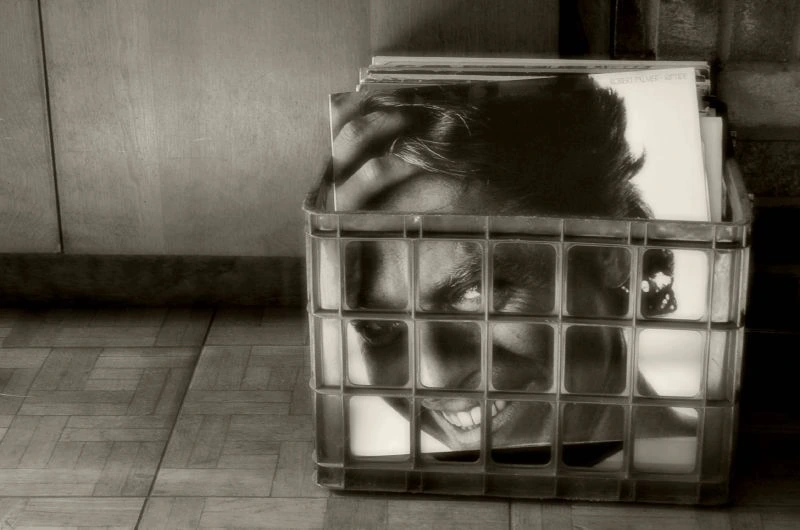
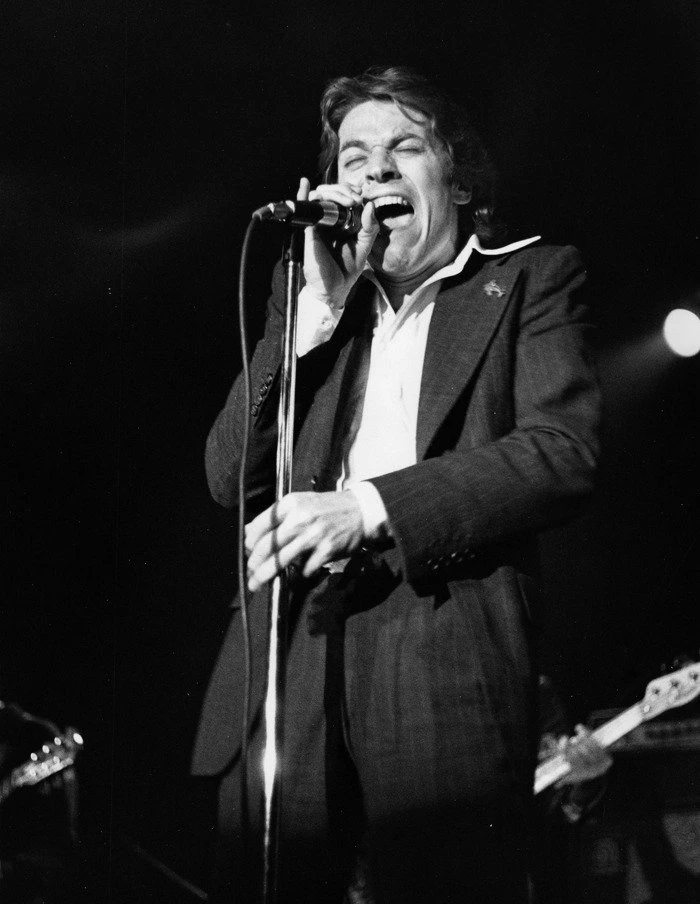
Robert Palmer, Before the Wall of Prancing Zombie Models.
Some remember Robert Palmer (R.I.P.) for addicted to Love and other such hits. Those lucky enough to remember the time of the original LP remember the Robert Palmer of sneaking Sally through the Alley and sailing shoes. Robert Palmer had many good songs after the initial hits of LP era yet it does deserve our serious attention to return to the sneak and Sally period for a closer look.
The Yorkshire kid who walked into Allen Toussaint's studio and walked out a cult hero.
Some remember Robert Palmer for "Addicted to Love" and its iconic video: a row of women with identical hair and impassive faces, dressed in black, miming guitars they'd never played. The video both helped and hurt—its imagery overwhelmed Palmer himself. Once you've seen those women lined up behind him, identical in dress and expression, doing stiff imitations of musicianship, the image lingers. For many, introduced to Palmer through MTV, this became their answer to who he was—no further questions asked. Discovering the musician Palmer had been in his twenties takes a deliberate effort, an effort most people don't make once the imagery sets in. Those who experienced the LP era firsthand know another Robert Palmer. The Palmer of Sneakin' Sally Through the Alley and the mid-1970s records were a young Englishman doing something strange and admirable: stepping into America’s legendary music rooms, where he had no claim to legitimacy, and earning respect anyway.
Before the Solo Career: Vinegar Joe and What It Cost Him.
Palmer mostly grew up in Malta, where his father served in naval intelligence—a stranger fact than it seems. This background meant he listened to music on American Forces Radio rather than the BBC. The blues and soul that shaped him arrived sounding a bit foreign, making them worth pursuing. The distance in those signals may explain why he spent his career chasing music’s roots. In the early 1970s, Palmer joined Vinegar Joe, a soul and rock band built around Elkie Brooks. According to available information, Palmer is backed by The Meters and Lowell George of Little Feat. Although Palmer received positive recognition within British music circles, his early solo albums did not achieve significant commercial success, and after several releases, he quietly ended this phase of his career, according to Wikipedia. Palmer left Vinegar Joe in early 1974 with an Island Records contract but little commercial recognition. The band’s most useful gift was Brooks herself, who set a standard for stagecraft and professionalism. Brooks had been performing since the mid-1960s and brought significant experience to the stage. Palmer, who started his own music career as a teenager in the 1960s, was new to the spotlight and used those two years to develop his unique sound while working alongside her. Vinegar Joe ended in early 1974, and Island had already signed Palmer as a solo artist.
Next came Sneakin' Sally Through the Alley (1974): The Audition Nobody Knew Was Happening.
The Louisiana sessions for Sneakin' Sally Through the Alley took place at Allen Toussaint's Sea-Saint Studios in New Orleans, and the album features the title track written by Toussaint and originally performed by Lee Dorsey, according to Apple Music. The assembled personnel were remarkable. Someone seemed to ask: What happens when an unknown English kid is paired with America’s top funk and soul musicians? Palmer’s main backing band was the Meters: Art Neville (keyboards), Leo Nocentelli (guitar), George Porter Jr. (bass), and Ziggy Modeliste (drums). In New York, producer Steve Smith hired session greats known as Stuff: Richard Tee (keyboards), Cornell Dupree (guitar), Gordon Edwards (bass), and Bernard Purdie (Aretha Franklin’s drummer). According to Sessiondays, Little Feat's Lowell George contributed the song "Trouble" to Robert Palmer's album, with Feat pianist Bill Payne playing the introduction. In 1988, he said, “The studio was full of these big black men from a heavy R&B church tradition, and I walked in and thought, Yoiks! I was paying the bill, but it felt like an audition. I swallowed hard and said, OK, everybody plugged in? Let’s go. And 16 bars into the first tune, they went, Hey, wait a minute. What did you say your name was?” That question, asked mid-song, is pivotal to Palmer’s early legend. Palmer successfully auditioned and joined the lineup for his first solo album, Sneakin' Sally Through the Alley, which is notable for its three-song opening sequence and features heavy influence from Little Feat and the funk fusion band the Meters, according to Wikipedia. According to Robert Palmer's album credits, the decision to open with Little Feat’s "Sailing Shoes" came about during rehearsal, where the Meters, who were not familiar with the original version, began improvising. Their take on the song features Palmer’s energetic vocals, Neville’s distinctive clavinet, and Vicki Brown’s lively background harmonies. “Sailing Shoes” segues into Palmer’s “Hey Julia,” which then explodes directly into the title track. "Sneakin' Sally Through the Alley," first recorded by Dorsey in 1971, erupts after “Hey Julia.” Nocentelli and George drive it loose and wild, harmonica flaring below, and Palmer’s voice commanding intensely. The whole track shines, especially Porter Jr.’s bass. According to information from Wikipedia, the album featured vocals originally recorded by Roden, but after the single succeeded, Robert Palmer re-recorded the vocals for "The Alan Bown!" album. I know better now. But I was trying for that funk-jam feel. The point was to get this groove I always had a feel for. And I got it, even more than I’d hoped for.”
The album’s latter tracks expand its range. The closing "Through It All There's You" stretches nearly twelve and a half minutes. It’s a studio jam that continued simply because, as Palmer later explained, nobody saw a reason to stop. He told The Daily News, “There was no reason to stop. We were just cueing the sections by numbers, which is how they do it in New Orleans. You know, 'Go to the three sections!' You’d just keep going until somebody woke up.Steve Winwood played on that track, bringing in a burst of additional energy. According to the album credits, "Get Outside," "Hey Julia," and Toussaint's "From a Whisper to a Scream" are all featured on Robert Palmer's 1974 album "Sneakin' Sally Through the Alley." The patience and stylishness Palmer and his band show on these tracks offer a refreshing contrast to the era's more overblown production trends. mid-1970s. As a result, homegrown, humid, and distinctly nontraditional, the atmosphere of Sneakin' Sally Through the Alley remains extraordinary even when compared with much better-known works by Leon Russell or Dr. John. According to the Official Charts, the album peaked at number 31 on the UK Albums Chart. Although Double Fun did not achieve major commercial success when it was released in 1978, the album showcased Robert Palmer’s skill in blending genres like blue-eyed soul, disco, and heavy rock, resulting in a distinct and well-produced pop record, according to Wikipedia.
Pressure Drop (1975): A Reggae Detour That Wasn't Really a Detour
After relocating with his wife to New York City, Palmer released Pressure Drop, named for the cover version of the reggae hit by Toots and the Maytals, in November 1975, featuring Motown bassist James Jamerson. In support, he toured with Little Feat to promote the reggae and rock-infused album. Wikipedia
Choosing Jamerson was worth a pause. According to album credits, Robert Palmer's 1975 release Pressure Drop included a cover of Toots & the Maytals' "Pressure Drop" and featured contributions from Little Feat. Recruiting Jamerson to anchor a young British singer’s record was no obvious move. It showed that Palmer wasn’t chasing commercial advantage, but was guided by respect for musicians and sounds he loved.
Pressure Drop is where Palmer’s eclectic instincts come alive on an album. His vocals transform each song, swooping through the groove, pushing it higher. The title track, already a reggae classic by Toots Hibbert, takes on new life with Palmer. It stays rooted in Caribbean rhythm but now has a distinctly transatlantic feel.
Although Pressure Drop only reached No. 136 on the US charts, college radio stations continued to play it, and music critics still covered Palmer's work more seriously than his sales numbers might suggest, according to Wikipedia. Although musicians discussed the records among themselves, according to MusicRadar, Robert Palmer's early singles, such as "Discipline of Love" and the title track, did not perform well on the UK charts.
Some People Can Do What They Like (1976): The Calypso Interlude
The third album arrived in 1976, and Palmer produced it himself for the first time. The album earned a minor hit with a bright, funky version of the calypso standard "Man Smart, Woman Smarter," a sound that pointed toward the Caribbean influences that would define his next record.
"Man Smart, Woman Smarter" had traveled an interesting route before Palmer got to it. Originally a Trinidadian calypso from the 1930s, it had passed through Harry Belafonte's hands in the 1950s before Palmer picked it up, and what he did with it was to strip out the novelty and leave the groove. According to Wikipedia, Robert Palmer's first solo album, "Sneakin' Sally Through the Alley," was recorded in 1974 in New Orleans, with strong influences from Little Feat and the Meters, though the album as a whole did not find a wide audience at the time. othold.
He moved to Nassau.
Double Fun (1978): The Hit Finally Arrives, and It's the Right One
Living directly across the street from Compass Point Studios, which was owned by Island Records founder and Palmer mentor Chris Blackwell, was not an accident. The Bahamas were where the record that finally broke through was made, and what broke through was "Every Kinda People," written by Andy Fraser, the former bassist for the British rock band Free.
Robert Palmer's song brought him his first Top 40 hit in the United States, reaching number 16, and the album further established his blue-eyed soul reputation with the upbeat, horn-filled "Come Over." According to the Robert Palmer discography, "You're Gonna Get What's Coming" was released as a single only in the US and Canada, where its promise was recognized, including by artists such as Bonnie.Raitt, who covered it on her seventh album, The Glow, in 1979. uDiscover Music
Palmer also returned to his relationship with Allen Toussaint's songbook, recording "Night People," a further testament to his ongoing appreciation for the New Orleans master whose work he had first engaged on Sneakin' Sally four years earlier. uDiscover Music
"Every Kinda People" is one of those songs that earns its keep by being almost unfairly well-constructed. Fraser wrote it with a kind of musical generosity that matches its lyrical theme: the arrangement has room, space for Palmer's voice to settle and breathe rather than push. It was the song Palmer needed for exactly this moment in his career, and it remains one of the cleanest performances of his early period.
Double Fun reached the top 50 on the Billboard chart, a meaningful jump from the 107 that Sneakin' Sally had managed four years earlier. The album felt like an arrival, and it was. Just not the arrival most people remember.
What These Records Were Doing
Taken together, the five years between Sneakin' Sally Through the Alley and Double Fun constitute a body of work that has no obvious parallel in British pop of that era. Palmer was doing something specific and unusual: treating American roots music as a serious artistic and intellectual project rather than a pose. He went to New Orleans because that was where the music he loved was being made. He recorded with the Meters, Lowell George, James Jamerson, and Bernard Purdie because those musicians could help him understand what he was reaching for.
As one retrospective reviewer described it, Sneakin' Sally was "tailored for the American white R&B market" and earned significant airplay on American college radio. That framing is accurate but undersells what Palmer was actually doing. He was not simply costuming himself in American music. He was studying it from within, absorbing it by making records with its most skilled practitioners, and working out what he could bring to it from where he stood. According to a New Musical Express review by Charles Shaar Murray, Robert Palmer's voice on Sneakin' Sally Through the Alley was described as "too pale and cool" to offset the album's clean and restrained production, leading Murray to feel that "it just doesn't catch fire anywhere." Listening today, that vocal quality may be interpreted differently. Palmer's unwillingness to push past what the song required was precisely what kept the Meters and Lowell George from swallowing him whole. The restraint was the point.
The prancing zombie models were still years away. The Terence Donovan videos that would make Palmer's earlier reputation almost impossible to locate through the glare had not yet been imagined. In the mid-1970s, Robert Palmer stood out among his British peers by collaborating directly with American musicians. For his first solo album, "Sneakin' Sally Through the Alley," recorded in 1974 in New Orleans, Palmer worked closely with members of Little Feat and the Meters, who served as his backing band, as noted by Wikipedia. The records they made together were worth the asking.
Cool Media LLC has covered music journalism since June 2012. We welcome readers who want to keep a record open longer than the algorithm allows.
Sailin' Shoes- Hey Julia- Sneakin' Sally Through The Alley: Robert Palmer
Sneakin' Sally Through The Alley is his debut album and probably the most underappreciated work in his discography. In 1974, after a three-year stint in the British rock/R&B band Vinegar Joe, Palmer left the group and signed a solo deal with Island Records. His next task was to search for session players for the album.
Recorded 10/13/1979 - Capitol Theatre (Passaic, NJ)
Copyright Bill Graham Archives
Robert Palmer - Sailing Shoes / Hey Julia / Sneakin' Sally Through the Alley - 10/13/1979
Robert Palmer Musikladen Radio Bremen TV Studios, Bremen, Germany Summer 1979
Robert Palmer - Musikladen (live 1979, full concert)
1. Love Can Run Faster 2. Under Suspicion 3. Come Over 4. Pressure Drop 5. Man Smart? Woman Smarter 6. Bad Case Of Loving You 7. Can We Still Be Friends 8. Sailin' Shoes 9. Hey Julia 10. Sneaking Sally Through The Alley 11. Best Of Both Worlds 12. Night People Robert Palmer - Vocals, Guitar Kenny Mazur - Guitar Steve Robbins - Keyboards Jack Waldman - Keyboards Pierre Brock - Bass Jose Caldo - Drums


