
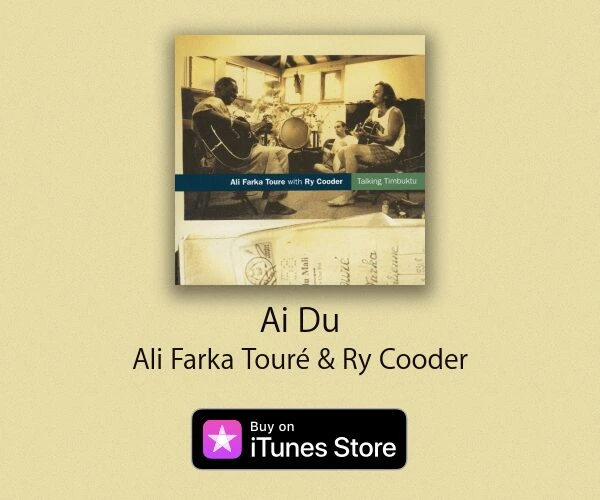

Ali Farka Touré wasn’t just a Malian guitarist—he was a musical ambassador. On “Ai Du,” his collaboration with Ry Cooder, Touré transforms longing into melody. Sung in Tamasheq, the track unfolds like a desert dawn: hushed, haunting, and utterly vivid. Its lyrics—“I travel to see my love…”—carry ancient longing, while the intertwining guitars echo a history stretched across continents. This isn’t a mere song; it’s a meditation on distance, desire, and devotion dressed in desert blues.
The Desert Speaks in Six Strings
Born on October 31, 1939, in Mali’s Timbuktu region, Ali Ibrahim “Farka” Touré rose from noble lineage to become a self-taught musical pioneer. Nicknamed Farka—meaning “donkey” in Songhai—for his stubborn resolve, he picked up the djerkel at twelve, swerved away from the griot tradition, and soaked in John Lee Hooker’s electric blues from across the Atlantic. What emerged was a fusion of Saharan cadence and Mississippi soul—a sound both timeless and tribal.1
“Touré’s music is the DNA of the blues.”2
That now-famous quote from director Martin Scorsese wasn’t hyperbole—it was history whispering back through time. On Ai Du, his 1994 collaboration with Ry Cooder, two guitar styles orbit one another: Cooder’s Americana slide and Touré’s cyclical Malian patterns. Their album, Talking Timbuktu, recorded in just four days, earned a Grammy and etched Mali’s soul into the global musical consciousness.3
“I’m a practitioner, not an academic … When I first heard Ali’s record, I thought he was playing the blues backwards … but I don’t think of him as a blues player now … I think of him as a rugged individual, but also one of the last of the real rural African bush musicians.” —Ry Cooder4
“You’d think Ali’s just goofing and jamming, but they’re all tunes, because these musicians don’t jam. Americans do, but Africans don’t. They don’t just blow; they play a song. And he says his melodies are ancient melodies and they have a purpose.” —Ry Cooder5
“He didn’t like to analyze these things, he only liked to play… It made the recording process very fast.” —Ry Cooder6
“I need to find Ali Farka Touré … of course I would play with him any time.” —Ry Cooder7
“I travel to see my love, but I cannot enter her house. I sing or play so that she will hear me and find a way to meet me.”8
Touré’s later albums—Savane, In the Heart of the Moon, Ali and Toumani—continued this deeply personal and profoundly political sound. Joined by griot and kora master Toumani Diabaté, Touré’s work became both reflection and resistance, chronicling a region’s beauty and its burdens.9
His final recordings in Bamako, laid down quietly while battling cancer, are not elegies. They are declarations from a man acutely aware he was making history.10
? Citations
- World Music: The Rough Guide, Simon Broughton et al., 1999.
- Scorsese, M., Feel Like Going Home, PBS, 2003.
- Grammy Awards Archive, 1995.
- Ry Cooder, Interview in Songlines Magazine, Issue #35, 2005.
- Ry Cooder quoted in World Circuit promotional interviews, 1994–2005.
- Nick Gold on Ry and Ali, MOJO Magazine, 2006 retrospective.
- Ry Cooder on working with Ali, BBC Radio 3: Music Planet, 2004.
- Liner Notes, Talking Timbuktu, World Circuit/Nonesuch, 1994.
- “Ali Farka Touré: The Roots of Blues in Africa,” Jon Pareles, NYT, March 2006.
- Toumani Diabaté, Songlines Magazine, Issue #39, 2006.
Ali Farka Touré Feat. Oumou Sangaré - Cherie (Official Video)
Music
Ali Farka Toure - Ai Du

If you're looking for a track that sums up the term FLOW, listen no further than this track, Aidu Du, from Ali Farka Toure (RIP) and Ry Cooder's album, Talking Timbuktu. My all-time favorite track to put on before the guests arrive for an outdoor party while setting up the grill.
Ali Ibrahim "Ali Farka" Touré (October 31, 1939 – March 6, 2006) was a Malian singer, multi-instrumentalist, and one of the African continent's most internationally renowned musicians. His music is widely regarded as representing an intersection of traditional Malian music and its North American cousin, the blues. The belief that the latter is historically derived from the former is reflected in Martin Scorsese's often-quoted characterization of Touré's tradition as constituting "the DNA of the blues". Touré was ranked 76 on Rolling Stone's list of "The 100 Greatest Guitarists of All Time" and 37 on Spin magazine's "100 Greatest Guitarists of All Time".
Written by Ali Farka Toure in Tamasheq (the Berber language of the Touareg, related to the Semitic languages and ancient Egyptian). Liner note: "I travel to see my love, but I cannot enter her house. I sing or play so that she will hear me and find a way to meet me. Then I must return home to wake early for work."
Enjoy.
Diaraby (with Ry Cooder)
Provided to YouTube by World Circuit Diaraby (with Ry Cooder) · Ali Farka Touré · Ry Cooder Talking Timbuktu ℗ 1994 World Circuit Limited, a BMG Company Released on: 1994-03-28 Sound Engineer, Mixer: Mark Ettel Sound Engineer: Bernie Grundman Producer: Ry Cooder Composer: Traditional Arranger: Ali Farka Touré
"Ai du" live by Vieux Farka Toure @ Joe's Pub
Like father, like son.... the flow continues.
Ali Farka Touré & Toumani Diabaté - Debe live at Bozar
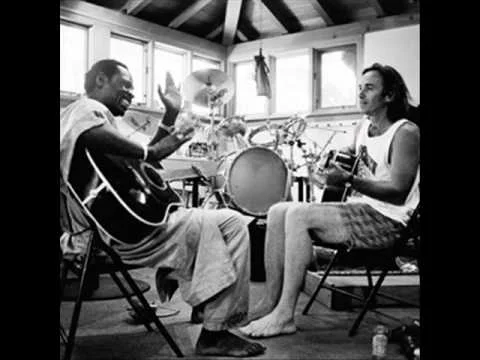
Ali Farka Toure and Ry Cooder-Ai Du
Musicologists may wax poetic about the connection between West African music and American blues, but this GRAMMY®-winning 1994 release—a genius collaboration between a Malian guitar legend and an American multi-instrumentalist/producer—was a groundbreaking proof-of-concept. Touré's hypnotic melodies (sung in 11 languages!) float over shimmering acoustic and electric guitars from Cooder and notable guests (including John Patitucci and Clarence "Gatemouth” Brown). Dusky, entrancing, and stunningly gorgeous, Talking Timbuktu transcends geographical and cultural borders.