

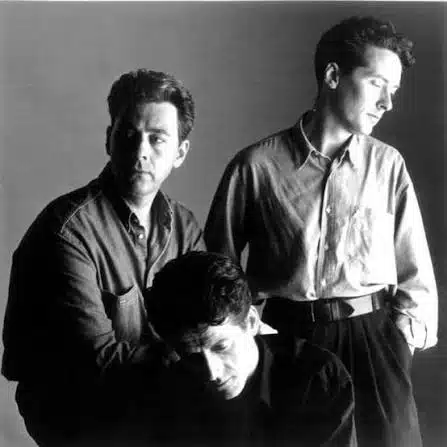
Now Blue Nile: Film Noir Atmosphere for Our Times
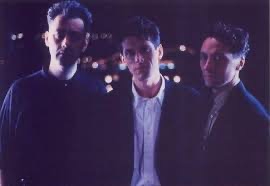
The Blue Nile, formed by childhood Glasgow friends Paul Buchanan and Robert Bell, is a moody synth jazz UK soul band. When they arrived aurally understated into our 1990 lives, we were not ready for them. They lasted due to the unique postmodern vibe, film noir, Berlin-Glasgow rainy night, 2 AM at the bar, by yourself, Paul Buchanan's vocal and sultry synth jazz/pop sotto narrativo. A band perfectly designed for our time.
By Paul Langan – Cool Media, LLC
"Stay… I will understand you."
Some music asks to be heard. The Blue Nile music emerges
softly. Like steam from a maintenance hole or the memory of someone who mattered, fading just enough to feel eternal.
Formed by childhood friends Paul Buchanan and Robert Bell in Glasgow in the early 1980s, The Blue Nile never fit the times—and that was their secret. In a world obsessed with louder, faster, shinier, they held a note until it broke your heart. Their debut, A Walk Across the Rooftops (1984), arrived like a whisper in the middle of a synth-pop hurricane. Its follow-up Hats (1989) was not so much a record as a midnight confession.
They weren't prolific. They weren't accessible. But they were, and remain, indispensable.
A Soundtrack for Solitude
There's something unshakably cinematic about The Blue Nile. Listening to Hats feels like watching a late-'60s Antonioni film set in post-industrial Scotland. The city is dark and wet, the characters isolated but yearning, and somewhere—just off-screen—Paul Buchanan is narrating in a voice that feels too intimate for radio and too ghostly for the stage.
It's hard to describe Buchanan's singing without falling into metaphor. His voice doesn't merely "emote"—it inhabits. It murmurs, pleads, retreats. It is the sound of a man looking back at a moment that never quite became a memory. He sings with such restraint that even silence becomes a kind of harmony.
And then there's the production—deceptively spare, yet intricate as a Rothko canvas—synth pads shimmer like fog over wet pavement. Drum machines don't thump; they breathe. Guitars appear like headlights in the distance and vanish just as fast.
This is music for the moments when nothing happens—yet everything feels. A missed call. A look across a crowded platform. A decision you won't undo but you'll always revisit.
Ghosts in the Machine Age
Much has been said about the noir aesthetic of The Blue Nile's work, and for good reason. They sound like 3 a.m. in a city that never quite wakes up. But the noir isn't just stylistic—it's philosophical. It's about detachment, displacement, and modernity as a maze.
Glasgow in the 1980s was a city between eras: old industry was fading while modernism was creeping in. The Blue Nile didn't document this transition—they embodied it. Their music occupies the liminal space between analog and digital, emotion and analysis.
In that sense, they were ahead of their time by decades. The world has finally caught up to their loneliness.
Designed for the Now
Why does The Blue Nile resonate now, perhaps more than ever? Because we live in their world. A world where connection is elusive, nights are endless, and beauty is something you glimpse between distractions.
As culture leans into maximalism—algorithms, autoplay, relentless dopamine—The Blue Nile remains a refuge. They require your attention but reward it with something better than content: context.
Buchanan once said: "We just wanted to make a record that would make people feel less alone." That is the manifesto of the moment.
The Legacy, the Silence, the Return?
After Peace at Last (1996) and High (2004), the band all but disappeared—at least publicly. Buchanan released the solo album Mid Air in 2012, a hushed and elegant postscript that felt like a coda to The Blue Nile's emotional architecture.
Rumors swirl about unreleased tracks, potential reissues, and even a possible return. But chasing those shadows seems counter to the band's essence.
The Blue Nile never demanded your loyalty. They only ever asked for your stillness.
Fade Out
Today, Hats plays as if recorded last week—or next year. Time doesn't touch it like all great film noir, absent of trend, abundant with feeling. And in that space, The Blue Nile still waits. Rain-soaked. Backlit. Eternal.
So play it again. And this time, let it wash over you.
The rain. The light. The ache. The sound of being quietly, beautifully understood.
The Blue Nile - Let's Go Out Tonight (Official Audio)
'Let's Go Out Tonight' by The Blue Nile taken from 1989 album 'Hats'.
The Blue Nile - Let's Go Out Tonight
Taken from the documentary titled "The Blue Nile – Flags and Fences 1990". I love how the quality of the video is not good, it adds to the aesthetic. I LOVE YOU, PAUL BUCHANAN.
Reflected in the water
When all the rainy pavement
Lead to you
It's over now
I know it's over
But I can't let go
The cigarettes, the magazines
All stacked up in the rain
There doesn't seem to be a funny side
It's over now
I know it's over
But I can't let go
From a late-night train
The little towns go rolling by
And people in the station
Going home
It's over now
I know it's over
But I love you so
The Blue Nile - From a Late Night Train (Official Audio)
Song
Artist
Album
Writers
Licensed to YouTube by
The Blue Nile - Saturday Night (Official Audio)
The Blue Nile - Over the Hillside (Official Audio)
Song
Artist
Album
Writers
Licensed to YouTube by
Lyrics
Workin' night and day
I try to get ahead
But I don't get ahead this way
Workin' night and day
The railroad and the fence
Watch the train go roll around the bend
Over the hillside
Over the moment
Over the hills and waiting
Workin' night and day
I try to get ahead
Workin' night and day
Don't make no sense
Walk me into town
The ferry will be there
To carry us away into the air
Over the hillside
Over white water
Over the hills and falling
The stars in your eyes
Knowin' what's right
The stars in your eyes
Don't explain
Over the hillside
Over the hillside
Over the hills and waiting
Over the hillside
Over the hillside
Over the hills and home, we'll go
Tomorrow I will be there
Tomorrow I will be there
Tomorrow I will be there
Oh, you wait and see
I can't go on and I can't go back
I don't feel so, a matter of fact
I tried and tried to make good sense
What's the good to try it all again?
Source: Musixmatch
Songwriters: Paul Gerard Buchanan
Over the Hillside lyrics © Wb Music Corp., Buchanan Music, Kobalt Music Services Ltd Kms
The Blue Nile - The Downtown Lights (Official Audio)
'The Downtown Lights' by The Blue Nile taken from the 1989 album 'Hats'.
The Blue Nile - Headlights on the Parade (Official Audio)
'Headlights on the Parade' by The Blue Nile is taken from the 1989 album 'Hats'.
Music in this video
Song
Artist
Album
Writers
Licensed to YouTube by
The Blue Nile - Easter Parade (Official Audio)
'Easter Parade' by The Blue Nile taken from their 1984 debut 'A Walk Across the Rooftops'.
Song
Easter Parade (2012 Remaster)
Artist
The Blue Nile
Licensed to YouTube by
UMG (on behalf of Virgin Records Ltd); ASCAP, UMPG Publishing, LatinAutorPerf, BMG Rights Management (US), LLC, Abramus Digital, UNIAO BRASILEIRA DE EDITORAS DE MUSICA - UBEM, ARESA, LatinAutor - PeerMusic, and 6 Music Rights Societies
Easter Parade
The Blue Nile
The line of traffic comes to a standstill
For the love King, out in the morning air
I find a place I started from
The wild is calling, this time I follow
Easter parade
In the bureau typewriter's quiet
Confetti falls from every window
Throwing hats up in the air
A city perfect in every detail
Easter parade
I know you, birthday cards and silent music
Paperbacks and Sunday clothes
In hallways and railway stations
Radio across the morning air
A crowd of people everywhere
And then the people, all running forward
Easter parade
Source: Musixmatch
Songwriters: Buchanan Paul Gerard / Bell Robert Angus
Easter Parade lyrics © Wb Music Corp., Berlin Irving Music Corp., Flag 22 Publishing, Buchanan Music, Kobalt Music Services Ltd Kms


The Blue Nile & Rickie Lee Jones - Easter Parade + Flying Cowboys
[Stereo] Two live [in-the-studio] performances with one song apiece from the respective performers, done in collaboration with the other artist[s].
Thank you PlayMy String THANG for confirming that, indeed, it is Sal Bernardi on guitar, as well.
The video has a few glitches, which do not alter the sound, while the Flying Cowboys' audio is mixed a bit "hot". This is how the source tape sounded to begin with.
The Blue Nile - Free Trade Hall, Manchester - 21/09/1990 (As broadcast by The BBC)
I used to really enjoy listening and indeed recording the BBC Radio 1 In Concert series on a Saturday evening during the 1970s, 1980s, and 1990s. I still have the cassette tapes and as the BBC has no immediate plan to make these available to the public I have decided to release close to 250 of these historical recordings on my YouTube channel.
--- DISCLAIMER! ----
Copyright Disclaimer Under Section 107 of the Copyright Act 1976, allowance is made for "fair use" for purposes such as criticism, comment, news reporting, teaching, scholarship, and research. Fair use is a use permitted by copyright statutes that might otherwise be infringing. Non-profit, educational, or personal use tips the balance in favor of fair use.
The Blue Nile - 'Here Come The Bluebirds' (Lyrics Video)
Song
Artist
Album
Licensed to YouTube by
Is the BMPCC 4K still worth it in 2021? | STOP ASKING
There seems to be an influx of videos on YouTube asking if "the BMPCC4K is still worth it." It's time to stop asking. In this video, we cover why it's still worth it in 2021 and for the next 5 years. What do you think?
BMPCC4K 2022 | Best budget cinema camera for filmmakers
Should you buy the Black magic pocket cinema camera 4k in 2022? Well, it depends. This is my journey and process on how I came to decide that is was the best camera for me and my budget. I've been using the BMPCC4K for over 6 months now so here are my thoughts.
A budding filmmaker like you needs the Blackmagic Pocket 4k VS Hollywood Movie Camera | Red Dragon
BMPCC 4K Review - I spent one year with the Blackmagic Pocket Cinema 4K, am I still in love?
BMPCC 4K Review - I spent one year with the Blackmagic Pocket Cinema 4K, am I still in love? Another BMPCC 4K Review?! I didn't just buy the Pocket 4K and use it for a week. I used the BMPCC 4K for a full year before producing this in-depth camera review on the Blackmagic Pocket Cinema 4K to provide my fellow filmmakers with the knowledge they need before you purchase the Pocket 4K. Find out why in 2020, I think the BMPCC 4K is the best value cinema camera for filmmakers like you. Learn how I put this entry-level cinema camera to the test when it comes to filmmaking and videography work in the field. In this 1-year review, I also show you some BMPCC4K Footage that I've shot, as well as show you some low-light footage from the BMPCC 4K.


