

LP: The Vocal Phenomenon America Discovered Too Late
I arrived fashionably late to the LP phenomenon. Regular readers might reasonably point out that my musical allegiances typically lie with artists who cut their teeth in the late '60s and early '70s. Fair enough. But my counterargument has always been simple: genuine artistry transcends genre, gender, era, and any other arbitrary boundary we might draw.
LP demolished that argument anyway.
The Voice That Demands Attention
Laura Pergolizzi possesses a vocal range spanning approximately three and a half octaves—from B2 to F6—but the numbers alone don't capture what makes LP's voice genuinely extraordinary. This is an instrument capable of delicate falsetto whispers and roof-rattling belts, sometimes within the exact phrase. The signature whistling technique that punctuates "Lost on You" isn't a gimmick; it's an organic extension of a vocal range that classical sopranos would envy.
What strikes you first about LP's voice is its power. This isn't studio-enhanced vocal presence or layered production tricks. LP can fill a room without amplification, a quality she shares with artists like Brandi Carlile, performers whose voices command attention through sheer force of nature. The vibrato is natural, expressive, and never overwhelming. The transitions between registers feel effortless, whether she's navigating the soaring chorus of "Muddy Waters" or the intimate verses of "Other People."
LP's mother was an opera singer, and that classical foundation shows in the technical precision beneath the rock-and-roll presentation. The breath control required to sustain those high notes while maintaining emotional intensity speaks to years of disciplined practice. But technique without soul is just an exercise. LP brings both.
The Long Road Through Seven Record Labels
Here's an artist who spent years in the industry trenches, writing hits for Rihanna, Christina Aguilera, and the Backstreet Boys. At the same time, seven different record labels couldn't figure out how to market her singular talent. Think about that for a moment. Seven labels. Not because the talent wasn't there. LP was clearly good enough to write chart-toppers for some of pop music's biggest names. The problem was simpler and more frustrating: she didn't fit the template.
LP's breakthrough as a songwriter came in 2010 when she co-wrote "Cheers (Drink to That)" for Rihanna's album Loud. The song features a vocal hook performed by LP herself, lifted from Avril Lavigne's "I'm with You." Rihanna told MTV News, "I love that song. That is one of my favorite songs on the album. It makes you feel like celebrating." That same year, LP co-wrote "Beautiful People" for Christina Aguilera, featured on the Burlesque soundtrack.
The songwriter credits kept piling up—Leona Lewis, Mylène Farmer, Cher Lloyd, Céline Dion. LP was making other artists sound great while her own career as a performer languished in label purgatory. Island Def Jam. Warner Bros. RedOne's 2011 Records. Each label saw the talent but couldn't solve the marketing puzzle: How do you sell an androgynous artist with a stratospheric vocal range who writes sophisticated pop songs but delivers them with rock intensity?
Europe figured it out first. "Lost on You" became inescapable across the continent, particularly in France, Greece, Italy, and Poland. The song topped charts throughout Europe while American radio largely ignored it. The video has amassed over 100 million views on YouTube, driven primarily by European audiences who understood immediately what American labels were still debating.
The Artistry Beyond the Voice
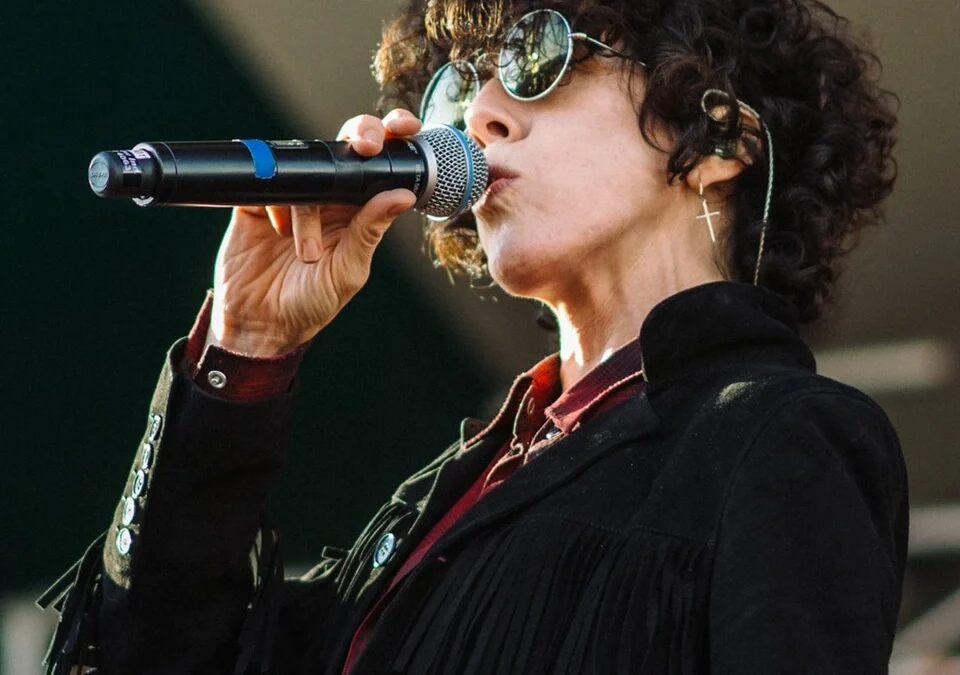
LP's androgynous presentation—the wild curls, the sharp suits, the ukulele that became her signature instrument after she discovered it in 2009- isn't calculated image-making. It's authentic self-expression from an artist who's never been interested in fitting prescribed roles. The Dylan comparisons are inevitable and not entirely off-base, but LP's influences run deeper and broader than that. She's cited Leonard Cohen, Roy Orbison, and Freddie Mercury as inspirations, and you can hear elements of all three in her work.
The ukulele choice is particularly telling. It's an instrument associated with novelty songs and beachside sing-alongs, not rock-inflected indie pop. But LP made it work precisely because she refused to let genre conventions dictate her artistic choices. The ukulele provides a melodic foundation without overwhelming that extraordinary voice, and in LP's hands, it becomes as legitimate as any guitar.
Live performance is where LP truly shines. Concert footage reveals an artist completely inhabiting the music, physically expressing every emotional beat. There's no distance between the performer and the performance, no protective irony or studied cool. When LP sings about heartbreak, you believe every word because she's right there in it with you.
As one longtime fan noted on YouTube: "LP is a phenomenal artist. I discovered her years ago. She is a breath of fresh air. My daughter has seen her twice in concert and has been blown away each time. She has a wonderful personality and is genuine. What you see is what you get."
That authenticity extends to songwriting. LP approaches composition with what she calls "a working-class approach to music." In a 2017 interview with Interview Magazine, she explained: "I'm a songwriter-singer. I'm very vocal-oriented, of course, but songwriting, no matter whether it's for myself or another artist, is of paramount importance to it all. I'm just looking to grow as a songwriter. I don't want to repeat myself."
Why Labels Couldn't Market Her
The record industry runs on templates. Female pop singer. Male rock frontman. Country storyteller. R&B vocalist. These categories exist because they simplify marketing, radio formatting, and retail placement. LP exploded every template simultaneously.
Too rock for pop radio. Too pop for rock stations. Too alternative for mainstream. Too mainstream for alternative. An artist whose vocal range rivals opera singers but who performs with a ukulele and writes songs that could work as either intimate ballads or arena anthems. How do you reduce that to a thirty-second radio spot or a Billboard category?
The answer, as it turned out, was: you don't. Europe embraced LP without needing to solve the categorization problem. American audiences are finally catching up, discovering an artist who's been making exceptional music for over fifteen years. The recent surge in reaction videos and viral moments suggests that LP is experiencing a second wave of discovery, new fans arriving late but with genuine enthusiasm.
The Invitation to Discovery
If you're among the newcomers, welcome. You've got a rich catalog to explore. Start with "Lost on You" if you haven't already—it's the song that broke through for good reason. The vocal performance alone justifies repeated listening. Then move to "Muddy Waters" to hear LP's belting technique at full power, and "Other People" for the vibrato and emotional vulnerability.
The album Heart to Mouth (2018) represents LP at her most confident, an artist who's finally making music entirely on her own terms after years of label constraints. Churches (2021) pushes even further into genre-defying territory. These aren't albums that reward passive listening. They demand engagement, attention to the lyrics, and appreciation for the craft underlying the emotional intensity.
LP's journey exemplifies an essential aspect of artistry in the modern music industry. The traditional gatekeepers—radio programmers, label executives, format consultants—are increasingly irrelevant when an artist can build a direct relationship with audiences through streaming, social media, and touring. Europe understood LP's appeal immediately because listeners weren't filtered through American radio's rigid format requirements.
Quality always finds its audience eventually. Sometimes it just takes longer than it should. LP spent years writing hits for other artists while waiting for her own moment. That moment arrived, carried by a whistling hook and a voice that refuses to be ignored. American audiences are finally catching up to what European fans have known for years.
Consider this your invitation to join the party, however late. The music rewards the wait.
LP tracks for you
I am a little late to the LP fandom. Readers may rightly argue that my interests lie squarely with Artists who earned their stripes in the late 60s or early '70s. My argument is always that quality transcends genre, gender, time period, et al. Here are a few of her best tracks.
Explore More Vocal Powerhouses
LP's journey from behind-the-scenes songwriter to international phenomenon mirrors other artists who refused to be boxed in by industry templates. Discover more voices that transcend genre:
Quality transcends genre, gender, and era—these artists prove it.
https://www.coolmediallc.com/welcome/anderson-paak-the-free-nationals-durham-cool-yes/


